Sunday, November 17, 2019

Collective action for improving health services. Why the evidence will continue to be mixed and what to do about it.

2016-2019 has seen a proliferation of large studies, donor reviews and evaluations published on social accountability (especially in health), with seemingly contradictory findings. Yet, if we go behind the findings, there are key common lessons for practice, including those studies with null results. These lessons include, but are not limited to, the role of high-quality community-based facilitators, the value of collaborative approaches, and contributions to system strengthening and relationship building. We make a start in exploring these lessons across different studies. We aim to encourage new syntheses[1], going beyond randomized field trials. These are, badly needed to help guide practitioners and challenge researchers to explore questions, which build further knowledge, not on whether it works, but how, why, and in what circumstances.
Introduction

Social accountability[2] as a practice has different definitions, different frames of reference, different audiences and purposes. Different families of human development practice may lay claim to it, from human rights and social justice advocacy; democracy, governance, and participation; organizational science and systems dynamics; to more programmatic concerns for systems strengthening, quality of service delivery, and equity. Different framing will place social accountability as a goal, or as a process. Both operate on different timescales and levels of complexity. More importantly, both framings - goal and process - are legitimate.
Governments may react differently to these different agendas and framing, and, additionally, different layers of government may look at social accountability differently based on where “systemic pressure” is applied. We could also underline that a participatory process bringing clients and providers together to collaborate and problem solve, may generate genuine expression of social accountability (one party feeling accountable to the other within a dialogical relationship) without “social accountability” having ever been articulated as an approach, much less as a project.
By itself, this complexity can already explain some variance in demonstrated results. We have seen increasing research on the impact of social accountability interventions on access to and quality[3] of services, as well as experimental research on population level outcomes (mortality, malnutrition, etc.). After multiple single intervention randomised control trials, however, debate still rages within research, policy and donor circles, about their definitive impact for development outcomes per se.
Indeed, there was much collective hand wringing last year when two high powered randomised control studies in health landed with null results.[4] Yet another large RCT in India found the opposite - dramatic effects on stunting and vaccination rates.[5] 
Many social accountability practitioners (implementers, donors, and governments) have strong positions on its value from their experience, and practice is moving forward.[6] The risk for the community of interested parties is to see each positive RCT as a final validation, and every negative RCT as a disqualification. Evidence challenges are important fodder for scientific and intellectual debate. Research needs to continue, but we suspect that the final finding of “trial” approaches to evaluating social accountability will be “it depends” for a long time, and for a number of reasons.
Why a traditional reference to evidence will continue to be mixed.
Firstly, it is important to consider which outcomes are examined in these recent studies. In particular, negative findings came from RCTs testing for changes in population health outcomes. A number of donor evidence reviews, on the other hand – notably a DFID macro-evaluation, USAID’s Marshalling the Evidence review, and this year’s 3IE review suggest consensus for positive impact on intermediate service outcomes.
It’s when we draw the long causal chain to try and measure the development outcome that it becomes challenging. A blog is not going to satisfice the question of why that is, but there are inherent limitations to chasing the statistical significance of broad and somewhat distal systems interventions on health outcomes.
Secondly, the devil - or in this case, learning from RCTs - is in the detail. Social accountability is messy; we need to learn from all opportunities, while understanding the limitation of each study. RCTs are powerful tools, but relying on their finding without discussion of theory, context and model limitations, is probably one of the worst things we can do in applying science to development issues.[7],[8],[9] The complexity involved in genuine social accountability mechanisms include many necessary, but not sufficient context and process conditions, which may demand more dynamic and contextually grounded forms of investigation, from realist evaluation, to developmental evaluation. (All of which also have limitations, no doubt about it.)
Third, theory is important, and we are challenged to imagine management, political science, sociological, or systems science theories, supported by evidence, which would posit that complex human endeavours can succeed and endure without accountability. This accountability can take different forms (administrative, legal, financial, social), which can complement, or even substitute to another over time on a particular issue.[10] Some leading thinkers about social accountability have suggested that the argument should simply be framed around accountability itself.[11]
Furthermore, if accountability is a first principle for human systems, then the questions might have to move from “Does it work?” to “How do we balance different types of accountability to optimize results?”[12] “What conditions allow for social accountability to be stepped up when administrative accountability starts to lag?” and “How much can we get from institutionalized social accountability mechanisms?” “What are central mechanisms from data to negotiation, which optimize the interaction between state and citizen in the delivery of public health services?”
Finally, trial methodologies framed around testing survival of patients at a time T, may need to evolve seriously to consider the dynamical processes (at times T1, T2…Tn) through which an intervention (labelled “social accountability” or unlabelled but creating the space for it) can alter social structures and processes, which may—under certain preconditions—themselves contribute to: (1) improving a public service, (2) establishing a norm for sustaining a public good responsive to the expressed needs of citizens, (3) providing standing capacity to identify and respond to new challenges and conflictual situations, (4) bringing a new progressive framing—hence unanticipated by original researchers—in the conditions of delivery of a public service, and (5) what else?
We certainly have not circled the block on research and evidence on social accountability, but tried to shift a bit the direction of our collective discussion.
But now, what lessons can be taken from the range of studies mentioned above, whether they had positive or negative findings?
Here are some of our top suggestions:
  1. Community collective action occurs, with even minimum levels of support and encouragement. 
On this, the T4D / Harvard qualitative study (forthcoming) which will complement the published RCT showed how even a minimalist, time-bound intervention, while not ideal, still led to an average of five ‘social actions’ per village across 200 villages in Tanzania and Indonesia. That was approximately 1,139 social actions. If we consider what it takes to enable communities to speak up, then this is quite a positive outcome for the communities involved. The thorough qualitative work that has accompanied this RCT, mirrors much of what is captured in the grey literature for this work, and this makes it particularly valuable. Without this, the summary message that “it didn’t work” [to effect long causal chain health outcomes] could be seriously misinterpreted.
  1. Quality facilitation is essential.
Social accountability approaches need facilitators engaged with communities to support the civic education and empowerment processes required for communities to negotiate with their governments. Investment in facilitators is crucial, and has now been highlighted through several RCTs, notably, the India study earlier identified. The importance of facilitation has also been highlighted over many years by INGOs. A qualitative report for USAID in 2016 highlighted that progress in health service function was less where facilitation weaker. [13] 
As practitioners, we honestly hope the India study puts to bed what practitioners have advocated for a long time – and that budgets for facilitation will follow. The Indonesian Government and many state governments in India understand this and fund their own facilitators, albeit with their own challenges, indicating a critical ongoing need for non-government facilitators.[14] Indeed, a global call for community development facilitators in every village is the single compelling goal of the 5-year-old Community Led Development movement (CLD) made up of 70+ non-profits interested to progress community empowerment across agency and indigenous/international divides.[15]
  1. Non-confrontational collaboration is important and is valued by communities.[16]
There’s a large space for debate and definitional issues in addressing what is and is not “confrontational” in social accountability. We are not going to dive in at this point, aside from the short digression as an endnote.
The point that we want to note here is the positive finding for the value of non-confrontational collaboration, which comes from two in-depth studies, undertaken over the same period in Indonesia by Harvard University and for the World Bank’s Global Partnership with Social Accountability. It is also highlighted from a 3IE systematic review on citizen engagement, which found that:
“Citizen-service provider engagement is more effective when implemented through phased, facilitated processes that are framed collaboratively, as opposed to one-off accountability meetings that are interpreted as confrontational.”
This argues at a minimum that there are certainly ample time and space for the added-value of conflict-sensitive, problem-solving approaches to social accountability
A digression, if you allow--When governments, unfortunately not-so-rarely, decide to be blind and deaf to the aspirations of people, or of particular groups of people, giving power and voice to people will be more political and more confrontational at some point. This reflects a difference in framing of social accountability, as ‘projects’ versus ‘movement’. We are not going to debate here whether one form of social accountability is better than the other, or the possibility of an approach to social accountability “in the middle”.[20] We believe that different degrees of ‘confrontation’ will be needed at different times and in different places. Projects working within the framework of bilateral and multilateral agreements will likely be biased toward pragmatic and technical contributions—changing systems seemingly ‘from within’. Social accountability movements trying to defy bias, prejudice, and injustice remain much needed in the world, and will continue to be a force for change putting pressure on public administration. This tension is not exclusive to social accountability,[21] but certainly social accountability is a space for living with this tension. Projects have to tread carefully on political issues, while movements naturally seize political platforms more forcefully. We do not believe in disqualifying one or the other approach, or pitting them against each other. We are seeking progress through a “yes, and” dialogic approach.

  1. The first social accountability project supported by the Global Partnership for Social Accountability in Indonesia 5 years ago (completed last year) showed evidence of positive effects on systems strength, and relationship building with a network of groups and institutions, with shifts in power dynamics.
This obviously deserves more unpacking than we have space for here. Nonetheless, this is the first GPSA evaluation to capture it through a systematic concurrent evaluation, based on an initial theory[17] refined from the accrued evidence. GPSA has seen evidence for these types of changes in other projects, as have several other INGOs. An earlier Columbia University study in 2017 also highlighted positive system strengthening and development coordination effects in Zambia from the same intervention methodology.
Conclusion
These lessons will not be new to many practitioners. Indeed, they appear sometimes obvious after many years of field experience. However, the inherently political nature of social accountability interventions and their intangible processes make their research, monitoring and evaluation complex[18]. To forge ahead, we--practitioners, researchers, policy-makers, and donors--consequently need different syntheses approaches, with rigorous and realist frameworks, recognizing multiple sources of learning and knowledge, and not pseudo-experimental black box approaches, to forge ahead.[19] As more sophisticated questions are devised in context, as multiple knowledge sources are recognised and alternative methods supported, we hope to see deeper, more nuanced learning develop for social accountability. This learning will especially be needed from assessments within the different social and political contexts, to inform the adaptation and evolution of social accountability mechanisms. This is true for citizens within these contexts, and for governments committed to ambitious Sustainable Development Goals.


Sue Cant & Eric Sarriot                 Nov. 2019
Sue Cant is the Social Accountability Adviser for World Vision International. This blog post is the opinion of the authors, but the thinking evolved through many one on one discussions and, in particular, a group convened earlier this year, who we would like to acknowledge: Courtney Tolmie, Florencia Guerzovich, Marta Schaff, Vicky Bowdell and, in particular, Angela Bailey. These colleagues helped improve the text, and we maintain sole ownership of its shortcomings.

Notes:
[1] Note, excellent 3IE synthesis in 2014 (Rogers, at al 2014)
[2] Collective action or transparency and accountability or multi-stakeholder governance, or put simply, any activity that helps citizens make government accountable with a tangible result.
[3] Quality in the broadest sense possible includes dimensions of equity, appropriateness, etc.
[8] R4D’s rich discussion of its own study findings (which were largely negative) has been an exemplar of commitment to intellectual rigor. Tolmie C et al., 2018 Presentation to American Evaluation Association ‘Speaking Truth to Power’ Conference, November 3, Cleveland Ohio
[10] Who can argue that the social accountability generated by the #MeToo movement is leading to more legal and even administrative accountability? In global health, one of us witnessed first-hand a participatory community engagement process lead to the expression of community grievances for more balanced ethnic and linguistic representation of the communities served by care providers. Once public administration responded, this became part of the way to manage the district and administratively address this element of population needs. Sustainability of the outcome meant that social mobilization no longer was necessary to maintain the service outcome. Social accountability (those words were not used) had led to institutionalized administrative norm, at least on this one pain point.
[12] For quantitative researchers, maybe a Bayesian approach needs to be suggested—what do we already know about the requirements for accountability in human systems? How does that inform our next research question?
[13] USAID, 2016, The Maternal and Child Survival (MCSP) Program, MCSP Community Component/Tanzania Community Scorecard Documentation Report, December.
[14] Forthcoming, Guerzovich et al
[16] This is not to say that contestation is not important. It is, but there are different approaches at different times that may work. 
[17] This was informed by a systematic realist review.
[18] Not to mention their implementation, as mentioned above
[19] Realist synthesis is one such methodology
[20] See forthcoming paper by Florencia Guerzovich and Maria Poli, which we will link to when available.

Thursday, May 30, 2019

Four Days at the World Health Assembly (continued) - Leveraging CHWs for UHC

As mentioned in my first series of updates, I attended an interesting side session to the WHA on CHWs and UHC organized by World Vision International (WVI). CORE's old friend, Tom Davis, facilitated the session. I'm too lazy to write all my notes about it, but I thought that one introductory presentation, in addition to being short [I'm a believer, but I'm not practicing] hit a lot of key points through the experience of WVI in different countries.

I'll try to have one more update on my time at WHA after that. But for now, I'm ceding the floor to Dan Irvine, Sr Director, Sustainable Health, WVI - here is his text with slides.
*****


The Universal Health Coverage goal today is presenting us a seemingly insurmountable challenge: 50% of the world’s population does not have access to health services; there is a current gap of 18 million healthcare workers.
Additionally, the UHC agenda is opening up a realm of health and well-being issues that historically have not been prioritized - issues like mental health, early child development, violence, sexual and reproductive health, non-communicable disease, and nutrition.  Our colleagues in the health system, and particularly at the front lines, are increasingly straining to effectively address these needs.

So who better to ensure that all people, everywhere, are reached with diverse health services than community health workers?  CHWs have always been at the heart of the Primary Health Care movement.  Since Alma Ata they have represented one of our strongest links between formal health systems and communities. 

We know today that CHWs are successful health agents when they are appropriately supported.  The WHO CHW guidance published last year, and the CHW resolution that will be passed in this 72nd world health assembly, are testaments to a new global confidence in the potential of CHWs, supported by an ample evidence base.  WHO notes that CHW platform support has been “uneven”, and in my experience that is certainly true.  World Vision frequently employs the CHW Assessment and Improvement Matrix to assess CHW program functionality, and we often identify sub-optimal support, for example in supportive supervision and incentive structures.

This has to change.  I believe one of the key messages of this session today is to advocate utilization of excellent available global CHW guidance, including the most recent WHO guidance, as well as many other important tools, some of which are listed on your handouts.  We should not be seeing today gaps in CHW platforms that have been identified consistently over the past years as marginalizing CHW results.  We have identified these challenges, we have developed guidance for implementers to address them – we all need to use the guidance, and shame on us if we don’t.

Now let’s talk a bit more about the next generation of CHWs…  In 2015 I directed a census of CHWs being supported by World Vision in 48 countries around the world.  One of the outcomes of our census that I found particularly intriguing was this analysis of the diverse activities they were engaging in – 25 activities in all.  As you consider the proportion of engagement in each activity, bear in mind that this is based on 220,000 CHWs we supported at the time.

You will note that amongst the activities many are closely aligned with core reproductive maternal, newborn child health and nutrition interventions.  But note also that nearly half of the programs state addressing early child development, 37% addressed adolescent health, and over half supported parenting groups. 

Over the last few years we have been exploring somewhat non-traditional roles for CHWs.  This month we are just concluding a study in four countries: Kenya, Tanzania, Myanmar and Bangladesh, on CHW address of violence against children.  This follows a study we published last year examining national policy alignment with the WHO Action Plan to Combat Violence, wherein we found some positive trends, but little policy implication for CHWs.


In the current study we interviewed 412 CHWs across these countries and have frankly been somewhat surprised to find that the majority already consider addressing violence against children as part of their role, they observe situations of violence in the household, and are actively intervening.  They also state a desire for capacity building to better address this violence.  With 1.7 billion children facing situations of interpersonal violence each year globally, World Vision will be testing how to best support CHWs to help them.

Last year we were thrilled to see publication of the Nurturing Care Framework for Early Childhood Development, which calls for an integrated approach towards the young child cohort inclusive of health, nutrition, water and sanitation, early stimulation, child protection and caregiving.  The framework suggests a critical role for the frontline health workforce in these objectives as this cadre most typically engages families in regards the well-being of young children.  In our experience, once again it is CHWs that present one of the best opportunities to support this multi-sector approach.

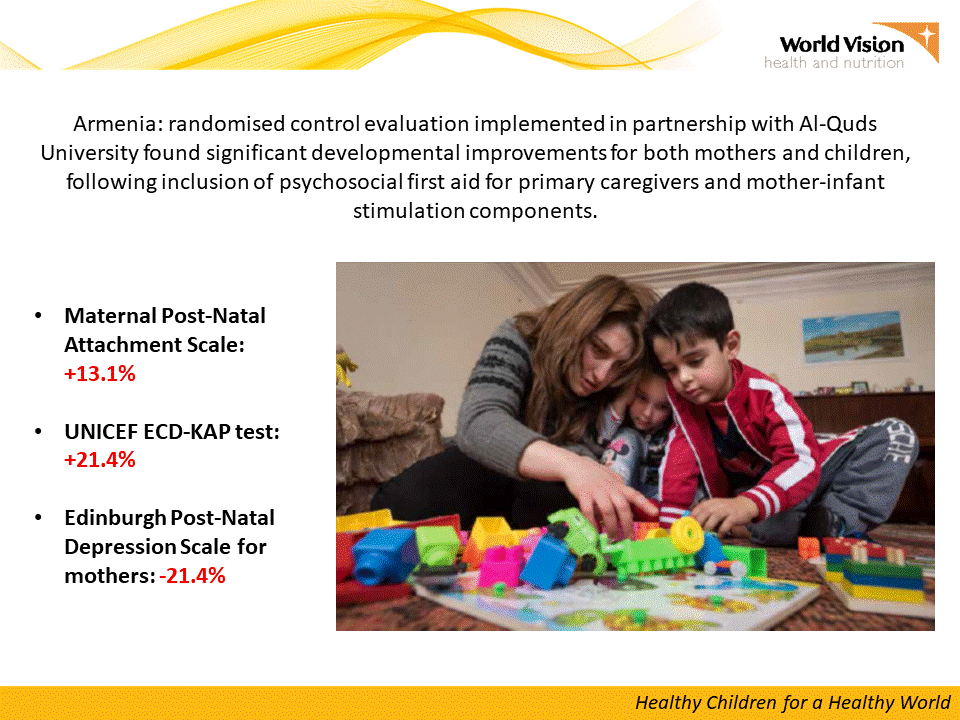
World Vision began integrating early child development interventions into core health CHW platforms many years back, and have worked with partners at Harvard, Aga Khan, Johns Ho

pkins and Al Quds universities to evaluate impact of the approach in a number of countries.  In this example in Palestine we found that inclusion of psychosocial first aid and early stimulation components resulted in significant gains across three standardized ECD scales, with positive effects for mothers as well as the children.

Time after time, whether it be diagnosis and treatment of infectious disease, treatment of severe acute malnutrition, or addressing violence and caregiving, we have seen that properly supported lay health workers can effectively extend service coverage.  In this case World Vision worked with WHO and the University of South Wales to test CHW delivery of a mental health intervention addressing distressed victims of gender-based violence in Kenya. 
The Problem Management Plus intervention involves facilitation of five behavioral treatment sessions with distressed women on an individual basis.  Our trial in Kenya demonstrated that the CHW facilitated approach outperformed the standard enhanced usual care approach.

Once again, Universal Health Coverage means that all people, everywhere, have affordable access to support for all issues affecting their physical and mental health and well-being.  If we are to realize this goal we must have a strong primary health care system, and I believe that CHWs are at the heart of that system.

Dan Irvine. 5/21/2019 [Dan_Irvine at WVI dot Org]

Monday, May 20, 2019

Four Days at the World Health Assembly (WHA) - Eric's Journal

Le Palais des Nations
I'm in Geneva for the next 3-4 days on behalf of Save the Children and CORE Group. I'll be speaking briefly at a PMNCH, CORE, CLAC (Citizen Led Accountability Coalition), and Save event on "The Role of Government in Welcoming the Voice of the People." I'll also be covering as many of the HSS, PHC, community health, and UHC-related sessions as I can.

I'm going to use this blog to journal and report along the way...

  • Monday, May 20, 2019 -- Geneva, First day at the WHA
Starting the way with the Save the Children pow-wow, colleagues from Advocacy and Humanitarian Response, from the UK, Germany, Australia, and of course Switzerland (kindly hosting us) so far...
Keywords: UHC - ACCOUNTABILITY & CIVIC SPACE
Very timely - our SCUK have just released a UHC AND ACCOUNTABILITY INDEX. This short document presents data for dozens of countries on prioritization of PHC, financing of UHC, and interestingly on general health financing accountability and civic engagement.

Interesting reminders: links between availability of skilled health workers, and government financial committment with  U5 mortality, and interesting observation (see the last figure) that "countries with higher U5 mortality rates are often countries with less civil space."

-> Read the blog: "is civic space the cornerstone of UHC?"
-> Download The Universal Health Coverage and Accountability Index

stay tuned...


The WHA is a whirlwind of official sessions, business sessions, technical updates, and side sessions. Here are a few that I caught...

  • Still Monday, May 20, 2019 -- PHC session (aka Primary Health Care towards Universal Health Coverage and Sustainable Development Goals, official side event)
Keywords: PHC - UHC - SDGs ... and CHWs!
This official side event was sponsored by China, Denmark, Ethiopia, Iran, etc. I got there five minutes early - that was insufficient to have a seat among those arranged along the wall, around the central space of tables for official delegations. Apart from standing, the downside of that was absence of access to an earpiece for translations. So, I may have missed some of the wisdom of the Chinese and Russian presentations.

The dominant style at the WHA, I quickly figured out, is the reading of written speeches. It makes sense, in a context where everything is recorded, and where speakers represent their nation-state (when they have one) that written text would dominate. But it was very different from my usual conference experience.

The opening of that session and speeches I could understand restated loudly essential principles:
- no UHC without PHC
- health systems as a foundation of PHC and UHC
- the historical trajectory from Alma Ata to Astana
- the emergence of the PHC operational framework, the SDG accelerator (largely among global public private partnerships - more on that later), and still the need to build the evidence base.

One speaker ended his speech with "in the name of PHC and UHC"; I felt compelled to say 'Amen', but I resisted. I'll take all the signs of commitment and buy-in for PHC that I can take.

The Minister of Health of Ethiopia re-explained the Ethiopian model for PHC and community health that most of us are familiar with now. Of note, he explained how a bridge was needed between CHWs and the households themselves, how women were the bridge, and how this had led to the Health Development Army, renamed Women Development Army for the occasion. Given that our 'Beyond the Building Blocks' paper is finally under press, and that it articulates that very need for what we sometimes describe as a 'dual model' (CHWs becoming professionals, CHVs grounded in community life, with rational task distribution), I was naturally elated by this reference.

Other speeches were made -- it was interesting to hear how PHC could be described as a key concern in countries as different as Singapore, Ethiopia, and Denmark! Key message here: PHC is not an LMIC strategy, it's a fundamental Public Health strategy.

Quote from my notes (I think from the Singapore representative): "The definition of PHC will vary country to country depending on epidemiology, ..."
.
-> Spoiler alert: over the next few days, WHA72 endorsed a number of statements and resolutions, notably on Community Health Workers for the delivery of PHC. This built on the work of many people, WHO's official guidelines, support from governments including the USG as a co-sponsor of the resolution, advocates, implementers from civil society to countries in the last 50 years.
This historical resolution is available here.

  • Monday, May 20, 2019 -- Second Plenary Session
Keywords: everything - non-state actor
The General Assembly Hall (from the Edge of my Seat)
I found my place as a non-state actor in the impressive plenary hall of the 'Palais des Nations', and I will not try to summarize it for you. There is a lot of process and protocol happening. OK, since you insist I'll give you key words: 'health of all humanity', '75 agenda items', 'responsive health systems providing quality care', 'no one left behind' (the theme), 'affordable, essential, quality health', a 'normative assembly', 'commitment', 're-commitment', 'walk the talk', 'health, environment, climate change', 'Astana', 'second chance', 'domestic resource mobilization', 'responsiveness to the most vulnerable populations'...


Dr Tedros
I'll skip over the debate about whether Taiwan should get its observer status back, which was rejected (China and Pakistan opposed, in spite of the Marshall Islands and St Vincent and the Grenadines strong plea), and whether there should be a side session on the health conditions in the occupied Palestinian Territories, East Jerusalem, and the Golan Heights, which took place a few days later (in spite of forceful objections by Israel and the United States of America).

Finally, we got to the speech by Dr Tedros. That was my primary target...
Unfortunately Dr Tedros explained that he had already made his speech during a morning plenary and wouldn't repeat himself. I haven't seen the text online yet, but

-> You can watch Dr Tedros' speech here.

And, no, I don't have a summary. Sorry.


I'll add more notes in the coming days, starting with a very interesting session by our friends from World Vision on CHWs, and "Committee A" sessions, where my Save the Children advocacy colleagues made key contributions, as well as FHWC, Impact Coalition, Intrahealth, and too many others to name...

Sorry to leave you on a cliffhanger. Stay tuned...


Wednesday, November 14, 2018

Reposting - Scale 0 for change in health systems through social accountability

To be honest, the main reason I am reposting this blog that Karen Waltensperger and I wrote for the Frontline Health Worker Coalition is that I keep referring to it and not finding the link. But this allows me to illustrate one important point on social accountability.

Jonathan Fox (AU/ARC) speaks of 'vertical integration' of social accountability (link available on the original blog), not 'at scale', but 'at different scales.' This is a very important concept, and we're trying to address how these 'different scales' mean to the business of monitoring, evaluation, and learning through the CORE Systems for Health working group with our JHU colleagues. But it's important to understand what these different scales mean -- for example frontline services, districts, local government, national government, etc. It's not just that things get bigger "at scale", it's that -- as always -- 'more is different', aka the nature of the problem changes with the scale at which it is being tackled.

Think about it this way:

  • Scale 1: you're working with primary health care facility and the users' community to engage in some dialogue, maybe use a scorecard, get some discussion and action points on improving quality, have first action steps, review, etc. You will have to deal with facilitation, potential conflict, sense making, data generation, mobilization (of community, of health workers), behavior change (of everyone around), quality improvement, and negotiating skills with different stakeholders.
  • Scale 2: while you have similar motivations as at scale 1 (for example quality, equity, participation, empowerment, governance), you are now engaged in processes where the dialogues involve not a clinic in-charge and health committee leaders, but a district health officer and a local government representative. On the 'client' side, the work is lead or supported a local NGO leaders, or a coordination body for local CBOs or health committees. You will still have to deal with things addressed at Scale 1, facilitation, potential conflict, data, etc. But all these things will be very different qualitatively -- you'll need different facilitation skills, different rapport to power, etc. You'll be treading on very different waters; both mistakes and success will have very different consequences at Scale 2 than at Scale 1. It's not just 'more scale'; it's 'different scale'.
So, this blog from last year illustrates what happens at Scale 0 so to speak:why and how does a health leader in the broadest definition (health worker, clinic-in charge, officer, pharmacist, supervisor) change behavior leading to better health systems performance in the first place. As you move from Scale 0 (a person) to Scale 1 (a service structure), the boundary of your 'system' expands, and the number of relationships to take into account also expands. As the boundaries get bigger at Scale 2, the number of relationships will increase exponentially. At each level, it's largely about human behaviors -- but increasing scale = increasing complexity.

Research will need to continue taking us into the weeds, or stepping away to measure large effects.
Program evaluation and learning will need to zoom in on the most important parts to keep our eyes on, if we want to maintain some momentum.

In the meantime, here's a brainstorm about the weeds, 'inside the black box' of individual health leaders influenced by social accountability processes.

Eric

Thursday, October 25, 2018

Social Accountability -- 2 short videos on a community scorecard for health services in Malawi

First a video featuring the excellent Helen Mwale (then with Save, and now with MSH) produced on the fly last year by the SC Malawi team, about the Community Scorecard approach -- Save the Children was one of the implementers of the USAID/SSDI project - in this case using the scorecard tool developed originally by CARE, and used globally by dozens of organizations.
[Of note: we had an interesting session at HSR2018 with Gail Snetro, Paula Valentine, and Allison Foster in Liverpool contrasting the scorecard and the Partnership Defined Quality approach. Both have critical elements, and my personal bet is that the methods might continue to converge. I also suspect that their differences actually provide a way to be more responsive to context, by allowing emphasis on different parts of a rich process. I'm also eager to hear about a full day session on social accountability, also at HSR2018, organized by Renee Loewenson.]
Enjoy this quick orientation video from Save the Children (2017):

And here's another (2013) CARE Malawi video, as part of the 'power to the people' series:


And here's a link to a series of presentations by speakers in a special session on Social Accountability held in 2017 at Save the Children's with the DC Health Systems Board. View videos.

Wednesday, August 22, 2018

The emergency-to-development continuum: left to right, or right to left?


As global health and international development professionals, our assumption is often that the continuum between emergency and development goes:
Emergency –> to –> Development,
left-to-right.

As global health and community health professionals, we have to or we tend to look at the situation as technicians, clinical technicians, social and behavior change technicians, health systems governance, and management technicians, leaving the questions of why fragility occurs to social change activists and advocates. We are now more often paying attention to public and private sector accountability to citizens, through the lens of the necessary governance and leadership of health systems, clearly delineated in a 'building block'. And we focus this attention on the need to ensure quality of services, the requirement that health systems be responsive to clients, so that utilization increases and our interventions reach scale. We trade very cautiously on these democracy and governance issues – actually, we generally like to focus on governance and say little about democracy. Our individual beliefs, motivations, and passions are still heavily humanitarian, socially-oriented, and democratic. But during office hours, we couch them in skilled technical language. After all, in terms of improving health outcomes, the best performing countries are not necessarily the most democratic ones.

Some of us at least, and certainly in polite company, enter the world as neutral technicians, even if we are passionate about democracy and global justice. And there’s a reason for it: our legitimacy and credibility stems from this neutral technicity; it allows us to come in, respond to human suffering, and act on the levers of health systems behaviors – including at community level – to redress the performance of health systems. We inherit a world full of emergencies, and now we are questioning how we can get better at moving along the continuum from left to right: Emergency – to – Development. That’s our job; that’s where we make a difference; and our activist, rambunctious, political self does well to leave the stage to the community health or health system professional that we are.

But what if the world was not going left to right, but more and more, in so many places, right to left:  development-back to-emergency, via a path of chaos?

Let’s consider examples related to both internal and external influences:
  •        A country successfully moving on MDG and now SDG indicators, but creating substantial anti-democratic spaces: regional imbalance, presidency-for-life, ethnic blind spots if not repression, leading to an undercurrent of popular discontentment, one day resistance, uprising, violence, implosion of the national model…    
  •       A relatively stable country with a functioning health system becomes a pile of rubble, sent back generations in its development due in large parts to foreign interventions and acts of wars, including by industrialized nations, who happen to also be well-meaning donors…
  •       Global economic models come to prominence, with long ramifications and ripples in terms of the economic choices of nations, the potential corrupting factor of massive amounts of funds, displacement of social investments away from the poor, and increased national blind spots about the needs of the poor and vulnerable.
  •       Unmitigated environmental destruction and global climate change hit large regions severely, leading to increased humanitarian crises, aggravated social, economic, and ethnic upheaval, increased numbers of refugees, and corollary decreased ODA funds for development.

If these are rare and unfortunate occurrences, then we are better off to leave this to the activists, peacemakers, and social justice advocates of the world. The world is still going left-to-right; our entry point into technical issues will allow us to play our role for progress, while ‘staying in our lane’.
But if these are trends and not exceptions, if more often than not such factors lead the world to go:
Emergency <– to <– Development,
right to left,...

...then our cautious neutrality may lead us to see a lot of our work undermined or even wrecked to ruins tomorrow. We will face constant degradation on a large scale, persistent and intractable emergencies, our left to right emergency-to-development continuum will revert to theory, overtaken by downward spirals and de-development. If this is the case, then our neutrality does not facilitate our work, but rather undermines the sustainability of any progress we achieve.

So, which is it? Left to right? Or right to left? And what does it mean for us?